
What Is Reverse Osmosis and Should You Use It at Home?
If you’ve been researching water filters for your home, you’ve probably come across reverse osmosis (commonly called “RO”) and wondered whether it’s worth the investment. It’s one of the most effective water purification methods available for Australian households, but it comes with a few trade-offs that are worth understanding before you commit.
Reverse osmosis is a water purification process that forces tap water through a semipermeable membrane under pressure. The membrane contains microscopic pores (we’re talking roughly 0.0001 microns) that are small enough to allow individual water molecules through while blocking contaminants. The result is exceptionally clean drinking water, with up to 99% of dissolved solids, heavy metals, chemicals, and bacteria removed.
That sounds brilliant on paper (and it largely is), but the process also strips out beneficial minerals like calcium and magnesium that your body needs for hydration. That means if you’re drinking RO water daily, remineralisation is something you’ll want to think about.
In this guide, I’ll walk you through everything you need to know about reverse osmosis water, from how it actually works at a molecular level, to whether it’s safe for your kidneys, to how it compares against other filtration methods like activated carbon and ceramic filters. I’ll also cover the practical fixes for the most common complaints people have about RO water, so you can make an informed decision about what’s right for your home. If you’d like to start with the basics, I’ve also written about the benefits of a water filtration system for Australian homes.
Why Am I Thirsty After Drinking Reverse Osmosis Water? (And How to Fix It)
This is one of the most common complaints I hear from people who’ve installed a reverse osmosis system. You’re drinking plenty of water, but you still feel thirsty, sometimes even more thirsty than before. It’s not in your head. There’s a straightforward scientific explanation.
The reverse osmosis membrane removes virtually everything from your water, including the essential electrolytes your body relies on for proper hydration. Minerals like calcium, magnesium, sodium, and potassium all play a role in how your cells absorb and retain water. When you drink completely demineralised water, your body can actually flush out its own electrolytes to balance the mineral concentration, leading to increased thirst despite drinking plenty of fluids.
The World Health Organisation has noted that long-term consumption of demineralised water can lead to increased urine output, altered mineral balance, and reduced electrolyte absorption. For most healthy adults this isn’t dangerous, but it’s certainly not ideal. The good news is it’s easily fixed.
The Remineralisation Protocol: Three Methods That Work
Method 1: Install a Remineralisation Cartridge
The simplest long-term fix is adding an alkaline or remineralisation cartridge as the final stage of your under-sink RO system. These cartridges contain natural mineral media, typically calcite and corosex, that reintroduce calcium and magnesium as the purified water passes through. Most quality cartridges last 6–12 months depending on your household’s water usage.
If you already have an RO system installed and want to add a remineralisation stage, give me a call. It’s a straightforward retrofit that I can sort out in a single visit.
Method 2: Trace Mineral Drops
If you don’t want to modify your existing system, concentrated trace mineral drops are an affordable alternative. Add 2–3 drops per glass (or follow the dosage on the bottle) and you’ll restore the essential minerals that the RO membrane removed. You can pick these up from most health food shops across the Central Coast or order them online.
Method 3: The Pinch of Salt
This one sounds almost too simple, but it works. Add a tiny pinch of high-quality Himalayan pink salt or Celtic sea salt per litre of RO water. Unlike regular iodised table salt, these natural salts contain a broad spectrum of trace minerals, including magnesium, potassium, and calcium, that help restore electrolyte balance.
🧪 Try This Now
Take a glass of your RO water, add a tiny pinch of Himalayan salt and a squeeze of lemon. Drink it and note whether your thirst is quenched faster than with plain RO water. Most people notice an immediate difference.
Common Mistakes to Avoid
Using regular iodised table salt instead of mineral-rich salts. Table salt is heavily processed and lacks the diverse trace mineral profile you need.
Over-salting the water. You only need the smallest pinch per litre. If you can taste salt, you’ve added too much.
Ignoring filter replacement schedules. If your remineralisation cartridge is exhausted, you’re back to drinking pure demineralised water. Set a reminder to check it every 6 months.
✅ Self-Check Method
Monitor your urine colour and frequency. If your urine is consistently very pale or clear but you’re still feeling thirsty throughout the day, that’s a strong indicator you’re drinking demineralised water without adequate mineral replacement.
It’s Not Just About Drinking: Cooking With RO Water Matters Too
Here’s something most people don’t consider. If you’re using your RO tap for cooking (which most households do), the demineralised water is actually leaching minerals out of your food as well. A World Health Organisation review found that cooking with demineralised or soft water causes losses of up to 60% of magnesium and calcium from vegetables, meat, and cereals. Losses were even higher for other trace elements: up to 66% for copper, 70% for manganese, and 86% for cobalt. By contrast, cooking with harder, mineral-rich water showed much lower losses and in some cases actually increased the calcium content of the food.
This is another strong reason to add a remineralisation stage to your RO system. It’s not just about what you drink, it’s about what you cook with too.
Is Reverse Osmosis Water Safe for Your Kidneys and Daily Drinking?
This question comes up a lot, and I understand why. When you hear that RO water has “everything removed,” it’s natural to wonder whether that’s actually good for your health. The short answer is yes, reverse osmosis water is safe for your kidneys and for daily consumption. In fact, it can actually reduce the workload on your kidneys by filtering out heavy metals like lead and mercury, excess sodium, and other dissolved toxins before they ever reach your body.
The concern people raise is about what’s missing rather than what’s present. Because the RO membrane strips out beneficial minerals alongside the harmful contaminants, drinking only demineralised water over a long period can affect your body’s mineral balance. The World Health Organisation published guidelines noting that water low in calcium and magnesium may contribute to increased dietary mineral deficiency if those minerals aren’t replaced through food or supplementation.
For most Australians eating a balanced diet, the minerals lost through RO water aren’t a major health risk. You’ll get calcium from dairy, leafy greens, and fortified foods, and magnesium from nuts, seeds, and wholegrains. But if you want the best of both worlds, ultra-clean water that’s also properly mineralised, adding a remineralisation stage to your RO system is the smart move.
💡 Key Takeaway
RO water is excellent for removing toxins and reducing the load on your kidneys, but it’s not the healthiest water for daily drinking unless you remineralise it or maintain a mineral-rich diet. The filtration handles the bad stuff, and you just need to add the good stuff back.
If you have existing kidney issues, always consult your nephrologist or GP before making changes to your water supply. For general health, upgrading your RO system with a remineralising final stage is the simplest and most effective approach.
What Is Better: Reverse Osmosis or Filtered Water?
This is probably the most important question if you’re deciding which water filtration system to install in your home. The honest answer is: it depends entirely on your water source, what contaminants you’re dealing with, and what you actually want from your drinking water.
Reverse osmosis is the more thorough option. The semipermeable membrane removes up to 99% of total dissolved solids (TDS), including heavy metals like lead, per- and polyfluoroalkyl substances (PFAS), fluoride, chlorine, bacteria, and dissolved chemicals. If you’re on bore water, tank water, or you know your local supply has elevated levels of particular contaminants, RO gives you the deepest level of purification available for a domestic system.
Standard filtered water, typically using activated carbon cartridges, takes a different approach. Carbon filtration is excellent at removing chlorine, volatile organic compounds (VOCs), and unpleasant tastes and odours, while retaining the natural minerals that are already in your water. For homes connected to treated mains water that’s already safe to drink, a quality activated carbon filter often makes more practical sense. It’s cheaper to install, cheaper to maintain, and you don’t need to worry about remineralisation.
Water Filtration System Comparison
| Criteria | Contaminants Removed | Retains Minerals? | Typical Cost | Best For |
|---|---|---|---|---|
| Reverse Osmosis | Up to 99% including lead, PFAS, fluoride, chlorine, heavy metals, dissolved solids | No | $200–$600 | Contaminated water, well water, bore water, hard water areas |
| Activated Carbon Filter | Chlorine, VOCs, bad taste and odour | Yes | $30–$150 | Safe mains water where you want better taste |
| Ceramic Filter | Bacteria, sediment, some parasites | Yes | $50–$200 | Rainwater tanks, rural properties |
| UV Purification | Bacteria and viruses (does not remove chemicals) | Yes | $300–$800 | Disinfection for tank or bore water |
| Boiled Water | Kills bacteria only. Leaves heavy metals and chemicals behind | Yes | Free | Emergencies only |
Which System Is Right for Your Home?
Here’s a simple decision framework I walk my customers through:
Are you on bore water or a private well? Go with reverse osmosis. Bore and well water can contain elevated levels of dissolved minerals, heavy metals, and bacteria that carbon filters alone won’t adequately address.
Do you want to remove fluoride from your drinking water? Reverse osmosis is one of the only domestic filtration methods that effectively removes fluoride. Standard carbon filters don’t. In Australia, most municipal water supplies are fluoridated, so if removing fluoride is important to you, RO is the way to go.
Is your main concern taste and chlorine? A quality under-sink activated carbon filter will do the job beautifully at a fraction of the cost. You’ll get great-tasting water that still retains its natural mineral content.
Are you on tank water or rainwater? Consider combining a sediment pre-filter with either UV purification (for bacteria) or a full RO system (for comprehensive filtration). Many Central Coast properties rely on a mix of mains and tank water, so the right setup depends on your specific situation.
If you’re not sure which system suits your home, that’s completely normal. There are a lot of options and it can feel overwhelming. I’m happy to have a chat, assess your water supply, and recommend the best solution for your household. No pressure, no sales pitch, just honest advice.
Need help choosing the right water filter? Call Dylan on 0411 438 760 for a no-obligation chat, or request a free quote.
How Does Reverse Osmosis Actually Work? (In Plain English)
If you’ve ever tried to explain reverse osmosis to someone and watched their eyes glaze over, you’re not alone. The science behind it is fascinating, but it’s simpler than most people think once you strip away the jargon.
Think of a reverse osmosis membrane as an incredibly fine strainer, far finer than anything you’d find in your kitchen. The pores in the membrane are so microscopically small (around 0.0001 microns) that only individual water molecules can squeeze through. Everything else, including dissolved salts, heavy metals, chlorine, bacteria, pesticides, pharmaceutical residues, and microplastics, gets left behind and flushed down the drain as waste water.
The “reverse” part of the name refers to the direction of water flow. In natural osmosis, water moves from a low-concentration solution to a high-concentration solution through a membrane. Think of a plant root drawing water from the soil. Reverse osmosis does the opposite: it uses your home’s water pressure (or a booster pump) to force water from the concentrated, contaminated side through the membrane to the clean side. You’re essentially overriding what water molecules would naturally do.
The Stages of a Typical Home RO System
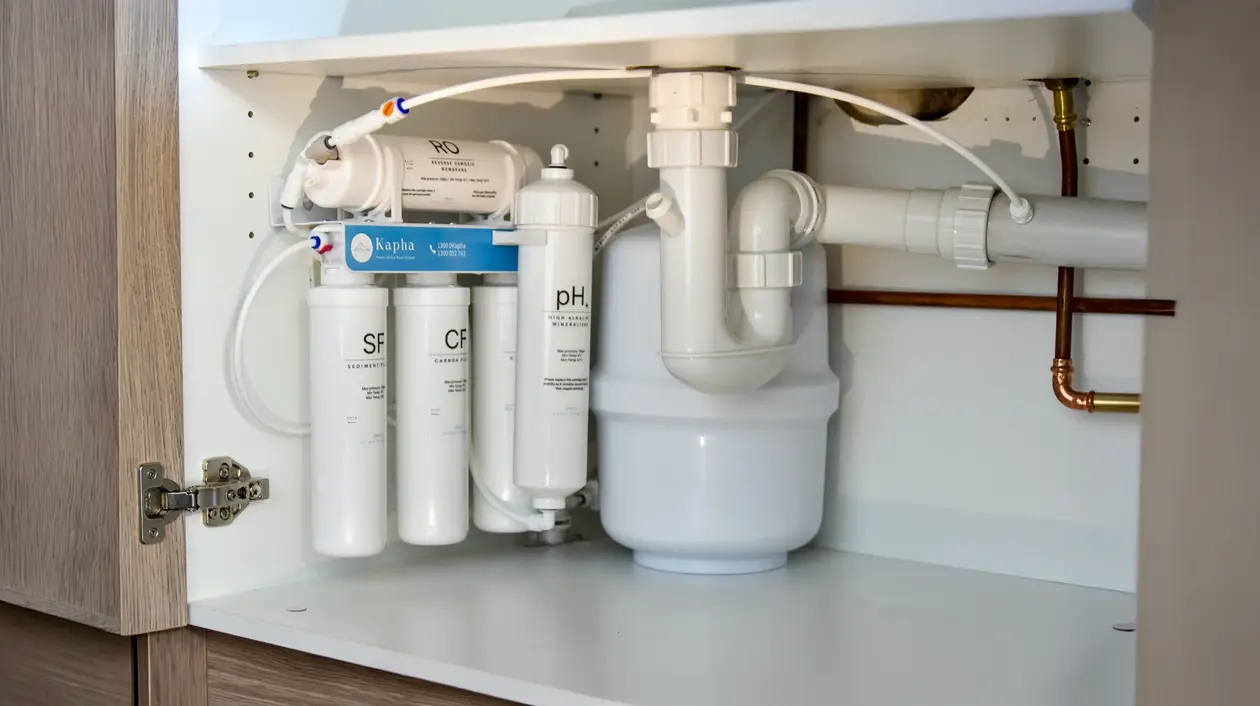
Most under-sink reverse osmosis systems installed in Australian homes include multiple filtration stages, not just the RO membrane itself. Here’s what a typical 4–5 stage system looks like:
Stage 1: Sediment Pre-Filter. Removes larger particles like sand, rust, silt, and dirt. This protects the more delicate membrane downstream from physical damage.
Stage 2: Activated Carbon Pre-Filter. Absorbs chlorine, volatile organic compounds, and chemical contaminants. Chlorine in particular needs to be removed before the water hits the RO membrane, as it can degrade the membrane material over time.
Stage 3: The RO Membrane. This is where the heavy lifting happens. The semipermeable membrane rejects up to 99% of total dissolved solids, including lead, fluoride, arsenic, PFAS, nitrates, and dissolved salts. The rejected contaminants are flushed away as concentrate (waste water).
Stage 4: Activated Carbon Post-Filter. A final polish that catches any residual taste or odour before the water reaches your tap. This is sometimes called the “coconut carbon” stage.
Stage 5 (Optional): Remineralisation Cartridge. As we covered earlier, this adds calcium and magnesium back into the purified water for improved taste and better hydration. I always recommend including this stage.
Why Major Brands Use Reverse Osmosis
Here’s something that surprises most people: many of the biggest bottled water brands in the world, including Dasani and Mount Franklin’s purified range, use commercial-scale reverse osmosis as the foundation of their purification process. Fast food chains use it too, which is why a Coca-Cola or a glass of water tastes virtually the same in Sydney, Perth, or New York. The RO process strips the water to a blank molecular slate, and the company then adds its own proprietary mineral blend back in for a consistent taste profile.
When you install a reverse osmosis system under your kitchen sink, you’re essentially getting the same core water purification technology that these multi-billion dollar companies rely on, just scaled down for a single household. The membrane technology is the same; the pore sizes are the same; the level of contaminant removal is the same.
Is Reverse Osmosis Worth It for Central Coast Homes?
If you’re on the Central Coast, you’re generally getting a good quality mains water supply from Central Coast Council. According to Council’s 2023-24 Water and Sewer Performance Report, they ran over 6,300 water quality tests across the year, covering both microbiology and chemistry, and every single result met the health guidelines set by the Australian Drinking Water Guidelines. Council supplies 85 million litres of drinking water daily to over 150,000 homes and businesses, and the Mardi Water Treatment Plant (which provides roughly half the region’s supply) is currently undergoing an $82.5 million upgrade to secure water quality for the future.
So your mains water is safe. But those tests measure compliance against health guideline thresholds, not the trace-level contaminants that many of my customers want to filter out. Things like PFAS (sometimes called “forever chemicals”), microplastics, chlorine by-products, and residual pharmaceutical compounds aren’t always captured by standard compliance testing. That’s the gap a home water filter fills.
Many of my customers across suburbs like Berkeley Vale, Terrigal, Gosford, Erina, and Bateau Bay install water filters because they want to remove the chlorine taste, reduce fluoride levels, or simply want that extra layer of protection beyond what standard treatment provides.
Whether you need a full reverse osmosis system or a simpler carbon filter depends on your priorities and your property’s water source. If you’re on mains water and your main concern is taste and chlorine, a quality under-sink carbon filter is usually all you need. If you’re on bore water, tank water, or you want the most thorough level of purification possible, reverse osmosis is the gold standard.
Either way, I’d always recommend getting a water quality assessment first so you know exactly what you’re dealing with. There’s no point over-engineering a solution if you don’t need to, and there’s no point under-engineering it if your water has specific issues that need addressing.
I’ve written a separate guide on whether it’s safe to drink tap water on the Central Coast if you want the full breakdown of what’s in the local supply.
Want cleaner, better-tasting water at home? TrueFlow Plumbing installs under-sink filters, whole-house systems, and reverse osmosis units across the Central Coast. Call Dylan on 0411 438 760 or visit our water filter installation page for pricing and options.
Frequently Asked Questions About Reverse Osmosis Water
Does reverse osmosis remove fluoride?
Yes. Reverse osmosis is one of the most effective domestic methods for removing fluoride from drinking water. The RO membrane typically removes 85–95% of fluoride, compared to standard activated carbon filters which remove little to none. In Australia, where most municipal water supplies are fluoridated, this is a common reason households choose RO over other filtration methods.
How much water does a reverse osmosis system waste?
A standard home RO system produces approximately 1 litre of purified water for every 3–4 litres of water processed, meaning 2–3 litres go down the drain as concentrate. Higher-efficiency systems are available that improve this ratio, and some homeowners redirect the waste water to gardens or laundry use. It’s worth factoring this into your water usage if you’re on tank water or a metered supply.
How often do reverse osmosis filters need replacing?
As a general rule for most Australian households: replace sediment and carbon pre-filters every 6–12 months, replace the RO membrane every 2–3 years, and replace the post-filter and remineralisation cartridge every 12 months. Your actual replacement schedule depends on your water quality, usage volume, and the specific system installed. I always set my customers up with a maintenance schedule when I install a new system so nothing gets forgotten.
Can I install a reverse osmosis system myself?
Under-sink RO systems are technically a DIY-friendly install for someone with basic plumbing knowledge, but I’d always recommend having a licenced plumber handle it. A professional installation ensures the system is connected correctly to your cold water line, the drain connection is properly sealed, and the system is pressure-tested before handover. If anything goes wrong with a DIY install, whether it’s a loose fitting, a cracked housing, or an incorrectly seated membrane, you’re looking at potential water damage under your kitchen sink. Getting it done right the first time is worth the peace of mind.
Is reverse osmosis water safe for babies and infants?
Reverse osmosis water is safe for preparing baby formula and for infant consumption, provided it has been remineralised. The Australian Government Department of Health recommends using cooled, boiled tap water for infant formula, but filtered water from a properly maintained RO system with a remineralisation stage is an equally safe option. If you’re using straight demineralised RO water (without remineralisation), speak to your paediatrician first.