
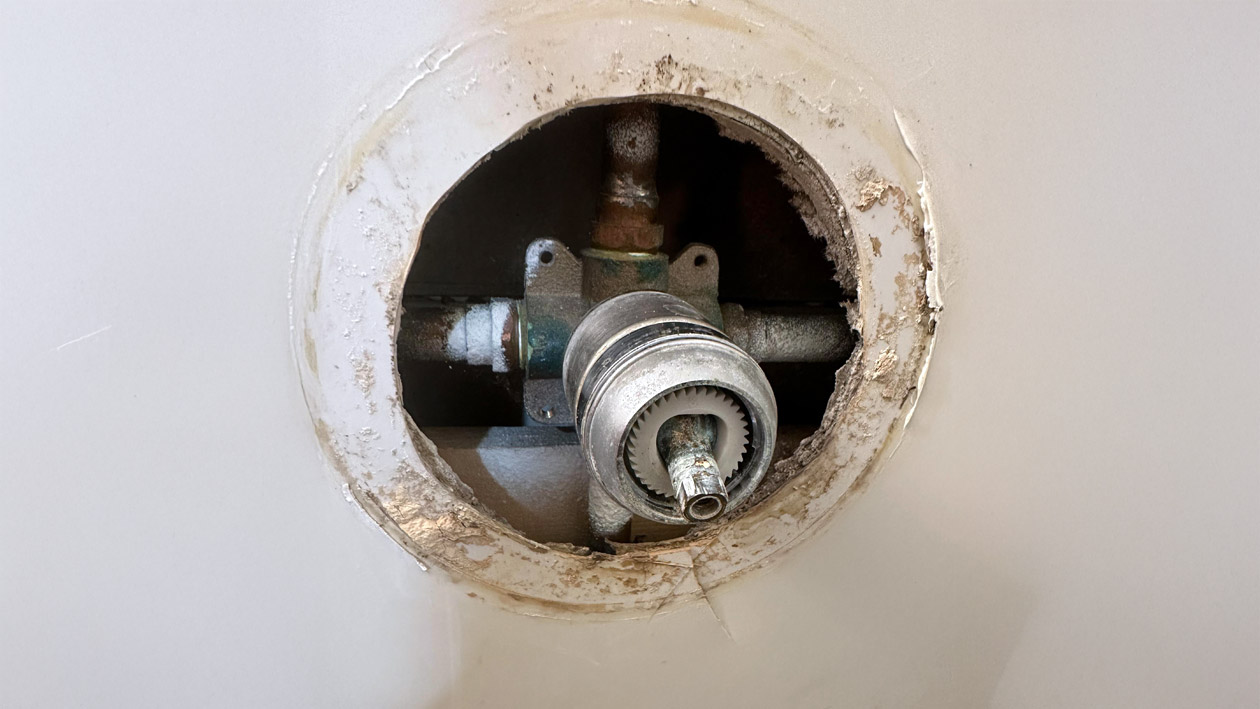
A shower valve controls water flow and temperature. If your shower drips, fluctuates temperature, or has a stiff handle, the valve cartridge likely needs replacing. While internal cartridges are DIY-friendly, replacing the entire brass valve body usually requires a plumber due to soldering requirements.
How do I know if my shower valve is broken?
Your shower valve is broken if it drips when off, suddenly changes temperature when someone flushes, has a stiff handle, or shows water damage on the wall behind it. Check our symptom decoder below.
| Symptom | Likely Cause | Severity |
|---|---|---|
| Dripping when off | Cartridge seals failed | High |
| Sudden temp changes (flush burn) | Pressure balance failure | High |
| Stiff/Grinding handle | Mineral buildup/Sediment | Medium |
| Low water pressure | Clogged valve inlet filters | Medium |
| Water behind wall (damp spots) | Valve body leak | Critical |
| Handle won’t stay in position | Worn valve stem | Medium |
| Constant hot or cold only | Mixing valve failure | High |
Immediate Action Items
Test: Turn the shower handle to the exact middle. Does the temperature fluctuate without moving the handle? This is a clear sign of broken pressure balance.
Listen: Put your ear against the wall near the handle. A hissing sound when off indicates an internal leak that needs immediate attention.
Check: Run your hand along the wall below the shower valve. Any dampness or soft spots mean water is leaking inside the wall cavity.
Isolate: If the low pressure happens only when you turn the handle to hot (but the cold side is strong), read our guide on how to fix low hot water pressure before assuming the valve is broken.
What are the three types of shower valves?
Type 1: Pressure Balancing (Most Common)
- Visual Cue: Single handle. Rotating it controls temperature; volume is usually fixed at 100%.
- How to Spot: Look for one handle that moves left-to-right for temperature control. Pull or push might control on/off.
- Best For: Standard residential bathroom repairs, preventing scalding when someone flushes the toilet.
- Common Brands: Moen 1222, Delta Monitor series, Kohler Rite-Temp.
Type 2: Thermostatic
- Visual Cue: Two handles (one for volume, one for temperature) OR a single handle with a separate temperature dial.
- How to Spot: Look for numbered temperature markings (often showing 38°C) or a separate temperature control knob.
- Best For: Custom showers, families with kids (anti-scald protection), luxury bathrooms.
- Common Brands: Grohe Grohtherm, Hansgrohe Ecostat, Kohler MasterShower.
Type 3: Diverter/Transfer
- Visual Cue: Usually the “middle” handle in a 3-handle setup, or a separate knob/lever below the main controls.
- How to Spot: This control directs water between tub spout and showerhead. Often a pull-knob on the tub spout itself.
- Best For: Tub/shower combinations where you need to switch water flow.
- Common Brands: Often integrated with the main valve brand.
What is the valve called? Understanding the Components
- Rough-in Valve: The brass part inside the wall (requires plumbing skills to replace)
- Trim: The visible handle and plate (aesthetic only, doesn’t affect function)
- Cartridge: The plastic/metal cylinder inside (the part that usually breaks and needs replacing)
- Escutcheon Plate: The decorative cover against the wall
Do I need a plumber to replace a shower valve?
It depends on what’s actually broken. If you’re just replacing the cartridge (the internal part that controls water flow), most homeowners can handle this 15-minute repair with basic tools. However, if you need to replace the entire valve body inside the wall, you’ll need a plumber – this involves cutting pipes, soldering copper, and risks major water damage if done incorrectly.
Scenario A: You Can Likely DIY If… (The Cartridge Swap)
- The leak is dripping from the showerhead
- You have a screwdriver and an Allen key
- You can see a “clip” holding the cartridge in place
- The valve has shut-off stops (small screws on the valve face)
- You can identify your valve brand and model
Verdict: DIY. This is a 15-minute repair involving replacing the internal cartridge, not the valve body. Cost: $30-80 for the cartridge.
Scenario B: You NEED a Plumber If… (The Valve Body Replacement)
- The leak is coming from inside the wall (wet spots on plasterboard)
- You want to change the brand of the shower valve (e.g., Moen to Delta)
- You don’t have an access panel behind the shower
- The pipes are copper and require soldering
- Your home was built before 1990 (likely has threaded galvanised pipes)
- You need to move the valve location
Verdict: HIRE. Risk of structural water damage is too high for beginners.
Decision Flowchart
- Is the leak inside the wall? → Yes = Plumber required
- Do you just want to stop a drip? → Yes = DIY Cartridge Swap
- Are you renovating the tile? → Yes = Plumber (install new rough-in)
- Can you turn off water to just the shower? → No = Plumber (need isolation valves installed)
Steps to Replace a Shower Valve Cartridge
Required Tools and Materials
- Cartridge puller tool (essential – don’t attempt without one)
- Allen key set (usually 3mm or 4mm)
- Phillips head screwdriver
- Silicone grease (not petroleum-based)
- New cartridge (exact model match)
1. Shut Off Water
- Locate main house shut-off valve OR
- Find isolation stops on the valve itself (small flathead screws on the valve face)
- Turn on a tap at the lowest point of the house to drain pressure
2. Remove Trim
- Pop off the handle index cap (usually has H/C markings)
- Unscrew the handle screw
- Pull handle straight off (may need gentle wiggling)
- Remove escutcheon plate (may have set screws)
3. Extract Cartridge
- Locate the “U” clip or retaining clip
- Pull clip straight out with needle-nose pliers
- Attach cartridge puller tool
- Turn clockwise while pulling to break mineral deposits
- Extract old cartridge (note orientation!)
4. Replace
- Compare old and new cartridges (must match exactly)
- Apply silicone grease to all O-rings
- Insert new cartridge in same orientation
- Replace retaining clip
- Reassemble trim in reverse order
Before buying parts, try to remove the handle. If the handle is seized and won’t come off, your “simple repair” just became a “call a plumber” situation. Test this before buying the new valve. Use penetrating oil and let it sit for 30 minutes if the handle seems stuck.
Critical Safety Notes
- Never force a stuck cartridge – you’ll crack the valve body
- Take a photo of the cartridge position before removal
- Keep the old cartridge to match at the hardware store
- If you see any cracks in the brass valve body, stop immediately and call a plumber
Post-Repair Testing
After reassembly:
- Turn water on slowly (quarter turns on the shut-off)
- Check for leaks behind the escutcheon plate
- Test temperature control through full range
- Let shower run for 5 minutes checking for drips
- Monitor the wall for 24 hours for any signs of moisture
Final Tip: If your shower valve is more than 15 years old and showing problems, consider having a plumber install shut-off stops during the repair. This $100 addition makes all future repairs DIY-friendly by allowing you to isolate just the shower without turning off water to the entire house.