
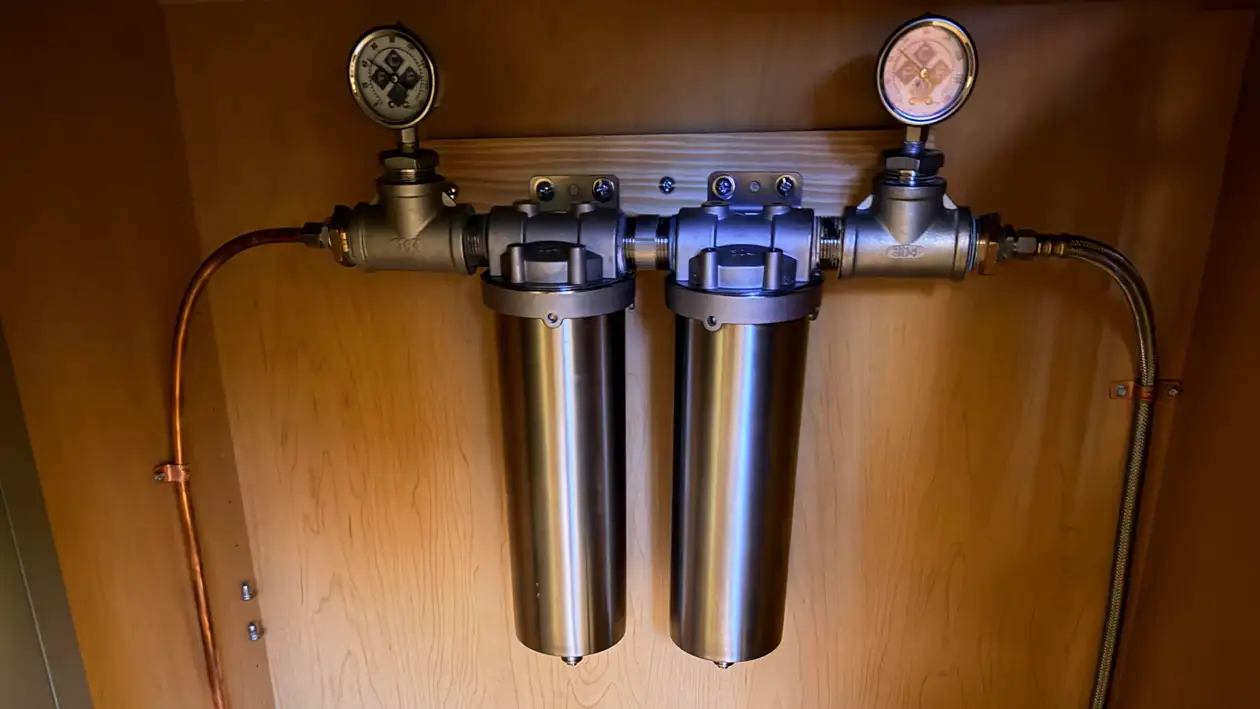
An under-sink water filter is a point-of-use purification system installed directly beneath your kitchen bench to remove contaminants from your tap water. These systems range from simple activated carbon filters to advanced reverse osmosis units, providing immediate access to clean, great-tasting drinking water right from your kitchen tap without taking up any bench space.
I install under-sink water filters across the Central Coast every week, and they’re by far the most popular option I get asked about. They’re hidden out of sight, they don’t clutter your benchtop, and a good one will handle everything from chlorine and sediment through to heavy metals and microplastics. But not all under-sink filters are created equal, and the right system for your home depends entirely on your water source and what you’re trying to remove.
This guide covers how under-sink filters work, the different types available, what each one actually removes, and how to choose the right system for your situation. I’ve also included a pre-installation checklist so you know exactly what to expect before any work begins.
What Type of Under-Sink Water Filter Is Best for Your Home?
The best under-sink water filter depends entirely on your water source. A reverse osmosis system removes the most contaminants (including parasites, fluoride, and heavy metals), while a multi-stage activated carbon filter is the better choice for improving taste and removing chlorine from treated town water without wasting water in the process.
There are four main types of under-sink water filters available in Australia, and each one suits a different situation.
Activated Carbon Block Filters
Carbon block filters use compressed activated carbon to adsorb chlorine, chloramine, volatile organic compounds (VOCs), sediment, and some pesticides. They’re the most common type of under-sink filter in Australian homes, and for good reason. If you’re on town water and your main concerns are taste, odour, and chlorine, a carbon block filter handles that job reliably at a low cost.
Most quality carbon block systems use a multi-stage setup: a sediment pre-filter to catch larger particles, followed by one or two activated carbon cartridges for chemical removal. Cartridge replacement is straightforward and typically needed every 6 to 12 months depending on usage. When comparing systems, look for filters tested and certified to NSF/ANSI standards (particularly NSF 42 for taste and odour, and NSF 53 for health-related contaminant reduction). NSF certification means the filter has been independently verified to remove what it claims to remove.
Best for: Homes on treated town water (like Central Coast Council supply) where the priority is better-tasting drinking water and chlorine removal.
Cost: $150 to $500 installed. For a detailed cost breakdown, see my guide on how much water filter systems cost in Australia.
Reverse Osmosis (RO) Systems
Reverse osmosis filters force water through a semi-permeable membrane with pores as small as 0.0001 microns. This removes up to 97% of total dissolved solids (TDS), including fluoride, lead, arsenic, mercury, nitrates, PFAS, bacteria, viruses, and parasites. An RO system is the most thorough filtration you can install under your kitchen bench.
The trade-off is that RO systems produce wastewater during the filtration process (typically 2 to 4 litres of waste per litre of filtered water, depending on the system), they require a drain connection, and they remove beneficial minerals like calcium and magnesium along with the contaminants. Some systems include a remineralisation cartridge as a final stage to add those minerals back in.
RO systems also need a pressurised storage tank, which takes up space under the sink. Before buying, measure the clearance inside your undersink cabinet to make sure everything fits.
Best for: Homes on bore water, well water, or tank water where heavy metals, bacteria, or parasites are a concern. Also suitable for anyone who specifically wants fluoride removed from their drinking water.
Cost: $500 to $1,200 installed.
Ultrafiltration (UF) Systems
Ultrafiltration uses a hollow-fibre membrane with pore sizes around 0.01 to 0.1 microns. It physically blocks bacteria, parasites, and suspended solids while allowing dissolved minerals to pass through. Unlike RO, ultrafiltration doesn’t produce wastewater and doesn’t require electricity or a storage tank.
UF is a good middle-ground option if you want parasite and bacteria protection without the water waste and mineral stripping that comes with reverse osmosis. It won’t remove dissolved chemicals like fluoride, lead, or PFAS on its own, but many UF systems combine the membrane with activated carbon stages for broader contaminant coverage.
Best for: Homes that want bacteria and parasite removal without the wastewater and mineral loss associated with RO systems.
Cost: $300 to $700 installed.
Ceramic Filters
Ceramic filters use a porous ceramic shell (often infused with silver to inhibit bacterial growth) to physically block sediment, bacteria, and cysts. The tiny pores in the ceramic element are typically 0.2 to 0.5 microns, small enough to stop most biological contaminants. Some ceramic under-sink systems combine the ceramic element with an activated carbon core for additional chemical removal.
Ceramic filters are durable and can be cleaned and reused multiple times before the element needs replacing, which makes them economical over their lifespan. They’re less common in under-sink configurations than carbon or RO systems, but they’re a proven technology, particularly popular for tank water and rural properties.
Best for: Rural properties or tank water homes wanting a low-maintenance, long-lasting filter for sediment and bacterial protection.
Cost: $200 to $500 installed.
Which System Is Right for You?
Here’s a simple way to narrow it down:
| Filter Type | Best Water Source | Removes | Doesn’t Remove | Installed Cost |
|---|---|---|---|---|
| Carbon Block | Town water (chlorinated) | Chlorine, chloramine, sediment, VOCs, taste, odour | Fluoride, heavy metals, parasites, bacteria | $150 – $500 |
| Reverse Osmosis | Bore, well, tank, or town water with specific contaminant concerns | Fluoride, lead, arsenic, mercury, bacteria, viruses, parasites, PFAS, TDS | Nothing significant (removes 95–97% of all dissolved solids) | $500 – $1,200 |
| Ultrafiltration | Tank water, bore water, or homes wanting bacteria/parasite protection without RO waste | Bacteria, parasites, sediment, turbidity | Fluoride, dissolved heavy metals (unless paired with carbon) | $300 – $700 |
| Ceramic | Tank water, rural properties | Bacteria, cysts, sediment (+ chlorine if carbon core included) | Fluoride, dissolved chemicals, heavy metals | $200 – $500 |
If you’re still not sure, ask yourself three questions:
- Do you own or rent? If you rent, a benchtop filter may be a better option because it doesn’t require any plumbing modifications. Under-sink systems need a dedicated filtration tap or a connection to your existing cold water line.
- Do you have space under the sink? Carbon block and UF systems are compact. RO systems need room for a pressurised storage tank (typically 28 to 35 cm in diameter).
- Do you need fluoride removed? If yes, reverse osmosis is your only reliable under-sink option. Carbon filters and UF membranes do not remove fluoride. I’ve covered this in more detail in my article on what boiling and filtration actually remove from water.
Should I Filter My Tap Water in Australia?
Yes. While Australian tap water is strictly regulated and safe from biological pathogens in urban areas, filtering removes aesthetic and chemical issues that treatment doesn’t fully address. Chlorine (or chloramine) is added deliberately to disinfect the water during transport through the pipe network, and while it does its job well, it affects the taste and smell of your water at the tap.
On the Central Coast specifically, our water comes from the Mardi Dam system and Mangrove Creek Dam, and it’s treated to meet Australian Drinking Water Guidelines (ADWG) standards. But by the time it reaches your kitchen tap, it’s travelled through kilometres of pipes, and the condition of that pipework matters. Older homes in suburbs like Toukley, Umina Beach, and Woy Woy may still have sections of galvanised steel or even lead-soldered copper pipe, which can leach trace metals into the water, especially when water sits in the pipes overnight.
One thing I should mention here, because it comes up a lot: water filtration and water softening are not the same thing. Hard water (water with high levels of dissolved calcium and magnesium) causes limescale buildup on taps, showerheads, and inside hot water systems, but it’s not a health risk. A water softener uses ion exchange resin to swap calcium and magnesium ions for sodium ions, reducing scale but not removing chemical contaminants. An under-sink water filter removes contaminants for drinking water quality. If you have both hard water and taste/chemical concerns, you may need both systems, but they serve completely different purposes. Central Coast water is generally moderate in hardness, so most homes here don’t need a dedicated softener.
If you’re curious about what’s actually in your water, here’s what I’d suggest before spending any money on a filter:
Pre-Installation Checklist
- Check your water quality report: Visit your local water utility’s website (for the Central Coast, it’s Central Coast Council) and download their latest drinking water quality report. This tells you exactly what contaminants are present and at what levels. If you’re on Central Coast town water, the supply generally meets all ADWG guidelines, but individual suburbs can vary.
- Measure your under-sink space: Open the cabinet and measure the height, width, and depth of the available space. Note where the cold water supply line enters and where the drain pipe sits. For a carbon block system, you’ll need roughly 35 cm of vertical clearance. For an RO system with a storage tank, you’ll need significantly more.
- Check for existing issues: Look for leaks, damp patches, soft or swollen cabinetry, weak bracing, or signs of previous water damage inside the cabinet. These need to be addressed before mounting any filter hardware. Heavy filter housings and pressurised tanks put load on the cabinet floor.
- Check your water pressure: Most under-sink filtration systems require water pressure between 200 and 500 kPa (roughly 30 to 70 PSI) to function correctly. Pressure that’s too high can damage RO membranes, and pressure that’s too low means the system won’t produce enough filtered water. If you’re not sure what your water pressure is, I can check it when I come out for a quote.
- Identify your pipe material: Is the pipework under your sink copper, PEX, or braided stainless steel? Different materials need different fittings and connection methods. This affects the installation approach and whether any adaptors are required.
Common Mistakes to Avoid
The two most common mistakes I see with under-sink filter installations are:
Not checking water pressure before buying an RO system. If your home has low water pressure (below 200 kPa), an RO system will produce water at a trickle and the storage tank will take hours to fill. You may need a booster pump, which adds cost and complexity. I always check pressure before recommending a system.
Ignoring the space a pressurised storage tank requires. An RO storage tank is typically 28 to 35 cm in diameter and 35 to 40 cm tall. That takes up a significant chunk of your under-sink cabinet. If you’ve got a waste disposal unit, a dishwasher connection, and cleaning products under there already, it might not fit. A tankless RO system is an alternative, but these cost more and have lower flow rates.
Why Am I Thirsty After Drinking Reverse Osmosis Water? (And Other Filter FAQs)
This is one of the most common questions I get from homeowners who’ve recently had an RO system installed. Reverse osmosis removes approximately 95 to 97% of all dissolved solids, including beneficial trace minerals like calcium, magnesium, sodium, and potassium. These minerals contribute to the hydrating quality of water, and drinking completely demineralised water can leave you feeling like you haven’t quite quenched your thirst.
RO water also tends to be slightly acidic (around pH 5 to 6) compared to regular tap water (pH 6.5 to 8.5), because removing dissolved minerals lowers the water’s natural alkalinity. This isn’t dangerous, but it’s another reason some people find RO water tastes “flat” or unsatisfying compared to mineral-rich tap water.
The World Health Organization has published guidelines noting that long-term consumption of water with very low mineral content may not be ideal, particularly in regions where dietary mineral intake is already marginal.
The fix is straightforward:
- Install a remineralisation cartridge: Most RO systems can have a remineralisation stage added as the final filter in the sequence. This adds back calcium, magnesium, and other trace minerals as the water passes through, restoring both the mineral content and a neutral pH. If your current system doesn’t have one, it’s a simple upgrade.
- Use trace mineral drops: If you don’t want to modify your system, liquid trace mineral drops are available from most health food shops. A few drops in your glass or water jug does the same job.
What Is the Healthiest Type of Water Filter?
There’s no single “healthiest” filter. The healthiest water filter for your home is one that removes the specific contaminants present in your water supply without stripping out everything beneficial. For most homes on Central Coast town water, a multi-stage activated carbon filter strikes the best balance: it removes chlorine, sediment, and chemical contaminants while leaving natural minerals intact.
If you’re on bore or tank water and need comprehensive protection, an RO system with a remineralisation stage gives you the cleanest possible water with the minerals added back in. For a broader look at the health and lifestyle benefits of home filtration, I’ve put together a detailed article on the benefits of water filtration systems.
Are There Any Downsides to Filtered Water?
Filtered water itself has no downsides. But certain filter types do come with trade-offs worth knowing about:
- RO systems waste water. For every litre of filtered water, an RO system sends 2 to 4 litres down the drain. Some newer systems are more efficient (closer to 1:1), but they cost more.
- RO removes minerals. As covered above, this can be solved with a remineralisation cartridge.
- All filters need maintenance. A filter that isn’t replaced on schedule can become a breeding ground for bacteria and actually make your water quality worse. Most under-sink cartridges last 6 to 12 months. I recommend setting a calendar reminder or keeping a log on the inside of your cabinet door with the date you last changed the filter.
How Long Does an Under-Sink Water Filter Last?
The filter housing itself can last 10 to 15 years or more with proper care. The replaceable cartridges inside are what need regular attention:
- Sediment pre-filters: Every 3 to 6 months
- Activated carbon cartridges: Every 6 to 12 months
- RO membranes: Every 2 to 3 years
- Remineralisation cartridges: Every 6 to 12 months
Signs it’s time to change your filter include a noticeable drop in water flow rate, a return of chlorine taste or odour, and water that tastes metallic or “off”. If you notice any of these, change the cartridge straight away rather than waiting for the scheduled replacement date.
Need an Under-Sink Water Filter Installed?
If you’re on the Central Coast and want an under-sink water filter installed, or you’d like advice on which system suits your home, give me a call on 0411 438 760. I’ll check your water pressure, assess your undersink space, and recommend the right system based on your water source and what you want to achieve. All installations come with upfront, per-job pricing and our Lifetime Labour Guarantee.
Dylan Attard
TrueFlow Plumbing and Drains
Licenced Plumber | NSW Licence No. 457032C
0411 438 760