
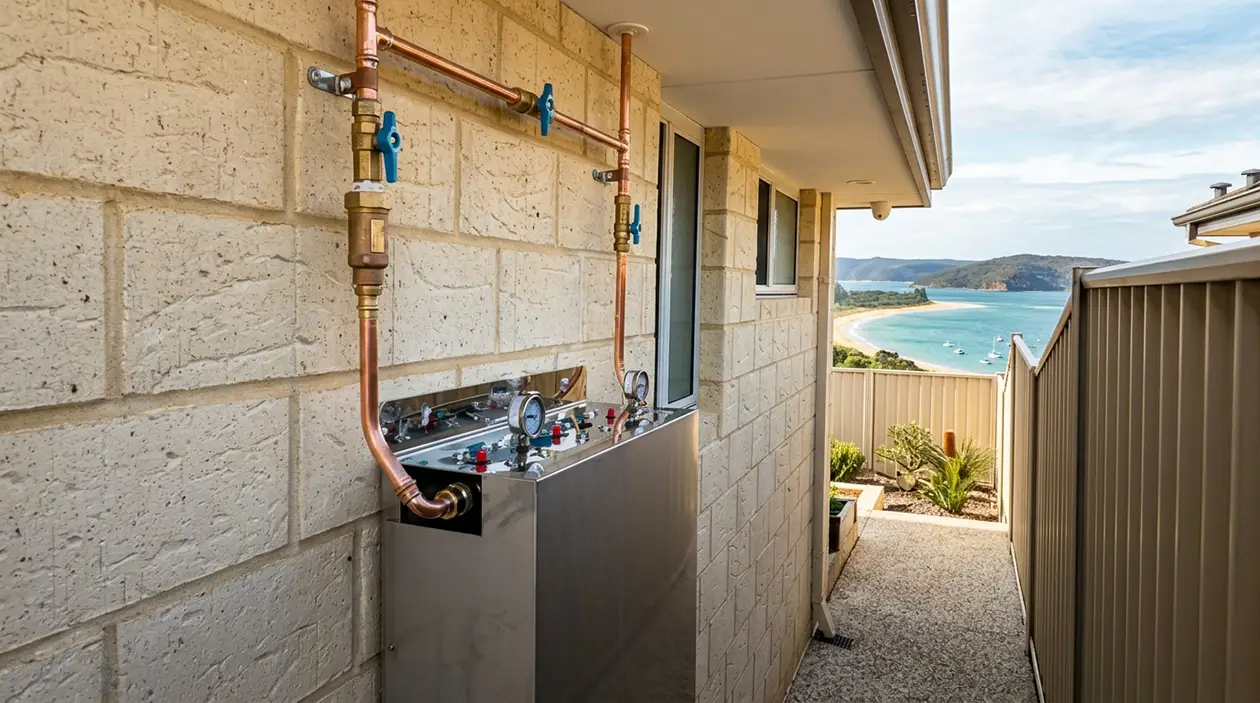
A whole house water filter is a point-of-entry appliance installed where your main water supply enters your home. It treats every drop of water before it reaches your taps, showers, toilets, and appliances, removing contaminants like chlorine, chloramine, sediment, heavy metals, and in properly specified systems, even parasites such as Cryptosporidium.
I install whole house systems across the Central Coast most weeks, and I’ll level with you: they’re not the right answer for every home. For some households, an under-sink filter on the kitchen tap does everything you need for a fraction of the price. For others, particularly homes on tank water, bore water, or older piping and plumbing fittings, a whole house system is the only setup that actually solves the problem.
This guide walks you through how to decide, how to choose the right system, what parasites and contaminants you’re actually protecting against, what it costs to install and maintain, and where the drawbacks sit. I’ll keep it practical, and I’ll flag the traps I see homeowners fall into.
Do You Actually Need a Whole House Filter (or a Softener)?
Before you spend a cent, work out whether your issue is contamination (a filter fixes this) or hardness (a softener fixes this). They’re different problems with different solutions, and I see people buy the wrong one all the time.
The 5-minute water symptom checklist
Run through the list below. Tick the symptoms that apply to your home, then read the verdict underneath.
| Symptom | What it points to |
|---|---|
| Water smells like a swimming pool | Chlorine or chloramine (filter) |
| Water tastes metallic, earthy, or “off” | Chlorine, iron, manganese, or tannins (filter) |
| White scale on kettles, shower screens, and tapware | Calcium and magnesium hardness (softener) |
| Soap won’t lather properly, skin feels dry after showering | Hardness, possibly combined with chloramine (softener + filter) |
| Cloudy, discoloured, or gritty water | Sediment, rust, or sand (sediment filter) |
| Sulphur / “rotten egg” smell | Hydrogen sulphide, often in bore water (specialised filter) |
| On tank or bore water, or recent boil water alert | Biological contamination risk (filter + UV) |
| Older home with galvanised or copper piping | Lead, copper, or sediment leaching from pipes (filter) |
Verdict: If you ticked chlorine or taste issues, a whole house filter makes sense. If you ticked scale only, you need a softener, not a filter. If you ticked both groups, you need a combined system. If you’re on tank or bore water, you almost certainly need a filter with UV sterilisation.
Three-step action plan
- Check your local water quality report. If you’re on mains water, Central Coast Council publishes annual Drinking Water Quality reports that show exactly what’s in your supply. Look at the chlorine, chloramine, fluoride, and hardness figures. These are measured against the Australian Drinking Water Guidelines (ADWG), which set the health-based benchmarks every Australian water supply is treated to.
- Do a simple home test. A basic TDS (Total Dissolved Solids) meter costs about $20 online and gives you a ballpark reading of dissolved minerals and salts. A hardness test kit adds another $15. For tank or bore water, skip the cheap kits and pay for a proper lab test through a NATA-accredited facility, expect $150 to $350 for a full panel covering bacteria, heavy metals, pH, and dissolved solids.
- Match your results to the system matrix below. Don’t guess. Buying a softener when you needed a carbon filter (or vice versa) is the most common and most expensive mistake I see.
Hard water or contaminated water: how to tell
Hard water is a mineral problem. It’s caused by calcium and magnesium dissolved into your water supply as it moves through rock and soil. It’s not a health issue, it’s an annoyance (scale) and an appliance killer (it shortens the life of hot water systems, dishwashers, and kettles). You fix it with a water softener, which uses an ion exchange resin to swap calcium and magnesium ions for sodium ions.
Contaminated water is a chemical or biological problem. It’s chlorine, chloramine, fluoride, lead, sediment, microplastics, or pathogens. You fix it with a filter: activated carbon for chemicals and taste, ceramic or sediment for particulates, reverse osmosis or UV for heavy contamination.
Central Coast mains water is generally moderately soft, so most homes in the region don’t need a softener. Hardness issues are more common on the outskirts and in areas running off tank water or bore water.
Which Whole House Water Filtration System Is Best for You?
The best system depends on your water source. There’s no single “top of the line” product that wins for every home. Reverse osmosis is the gold standard for purity but wastes water and isn’t usually configured for whole-of-house duty in Australian residential setups. Heavy-duty activated carbon systems are the workhorse for mains-water homes. UV purifiers are non-negotiable for tank and bore water.
System selection matrix
| Your water source | Best-fit system | What it removes | Typical installed cost |
|---|---|---|---|
| Mains water (town supply) | 3-stage whole house carbon system | Chlorine, chloramine, sediment, taste, odour | $1,300–$3,500 |
| Mains water with old piping | 3-stage carbon + 1-micron absolute cartridge | As above, plus lead, heavy metals, microplastics | $1,800–$4,000 |
| Tank or rainwater | Sediment + carbon + UV steriliser | Sediment, chlorine (if dosed), bacteria, parasites | $2,000–$4,500 |
| Bore water | Sediment + iron/manganese + carbon + UV | Rust, iron, sediment, bacteria, taste | $2,500–$6,000+ |
| Hard water (scaled appliances) | Softener + carbon combo | Calcium, magnesium, chlorine, sediment | $2,200–$5,000 |
| Maximum purity (drinking only) | Under-sink reverse osmosis (not whole house) | ~95–99% of dissolved solids including fluoride | $300–$1,500 |
Decision flowchart
Work through these three paths to land on the right category of system:
- Path A: Mains water, chlorine or taste focus. A 3-stage whole house activated carbon system is the standard recommendation. Stage 1 catches sediment. Stage 2 is carbon block. Stage 3 is a polishing carbon cartridge. This setup handles the vast majority of Central Coast homes on mains supply.
- Path B: Tank, bore, or well water, bacteria or parasite risk. You need sediment pre-filtration, an activated carbon stage, and a UV steriliser sized to your household’s peak flow rate. Consider adding a 1-micron absolute cartridge if Cryptosporidium is a concern.
- Path C: Hard water plus contaminants. A softener handles calcium and magnesium, and a downstream carbon filter handles chlorine, chloramine, and taste. The order matters: sediment filter first, softener second, carbon filter third.
Best for …
- Best for budget: A standard two-stage carbon system (sediment + carbon block), installed for $1,300 to $1,800. Adequate for most mains-water homes that want taste and chlorine handled.
- Best for parasites: A 1-micron absolute cartridge combined with UV sterilisation. This is the combo that genuinely removes Cryptosporidium. Nominal-rated filters don’t cut it (more on this below).
- Best premium setup: A custom multi-stage configuration from a reputable Australian brand like Puretec, Waterco, or Stiebel Eltron, with WaterMark-certified components and compliance to AS/NZS 3497 (drinking water treatment units). Expect to pay $4,000 and up.
If you want the full pricing breakdown with installation costs, cartridge replacement costs, and five-year total cost of ownership, read my water filter system cost guide.
Defending Against Parasites: Cryptosporidium and Bacteria
This section is the one most homeowners get wrong, and it’s the most important one in the guide.
Cryptosporidium is a microscopic parasite that survives standard chlorine treatment. It’s the same parasite that caused the 1998 Sydney water crisis and still triggers boil water alerts in catchment areas after heavy rain. To reliably remove it, you need a filter with an absolute pore size of 1 micron or smaller, or a reverse osmosis membrane. No exceptions.
The difference between nominal and absolute micron ratings matters:
- Nominal 1 micron: the filter will remove ~85% of particles down to 1 micron. Not safe for parasites.
- Absolute 1 micron: the filter will remove ≥99.9% of particles down to 1 micron. Safe for Cryptosporidium.
On tank and bore water, combine a pre-filter with a UV light system to fully sterilise incoming water. The UV lamp needs enough contact time to kill pathogens, so it has to be sized to your household’s peak flow rate, typically 15–60 L/min for a family home. An undersized UV simply passes pathogens through.
Try this now: Go and look at any water filter you currently own. Find the cartridge specification and check the micron rating. If it says “nominal 1 micron” or doesn’t specify, it’s not protecting against parasites. If it says “absolute 1 micron” (or smaller), you’re covered.
If you’re unsure about the safety of your water supply, my article on whether Central Coast tap water is safe to drink has the detail. And if you’ve been told to boil water during an alert, the article on what boiling actually removes explains the limits of that approach.
Whole House Water Filter Cost Breakdown and Installation
A whole house water filter costs between $800 and $6,000+ installed in Australia, depending on system complexity, water source, and site access. For a typical mains-water home on the Central Coast, budget $1,300 to $3,500 for a quality 3-stage carbon system installed by a licenced plumber. Ongoing cartridge replacements run $80 to $250 a year.
True cost: upfront plus five-year maintenance
| System type | Unit cost | Pro installation | 5-year cartridge cost | 5-year total |
|---|---|---|---|---|
| 2-stage whole house carbon | $300–$600 | $500–$800 | $300–$600 | $1,100–$2,000 |
| 3-stage whole house carbon | $600–$1,500 | $600–$1,200 | $500–$1,000 | $1,700–$3,700 |
| Carbon + UV (tank/bore) | $900–$2,500 | $800–$1,500 | $600–$1,300 (inc. UV lamp) | $2,300–$5,300 |
| Softener + filter combo | $1,200–$3,000 | $800–$1,500 | $500–$1,200 (inc. salt) | $2,500–$5,700 |
For the full pricing guide including under-sink, benchtop, and reverse osmosis options, see my complete water filter cost guide.
DIY or hire a plumber?
I’ll be straight with you: a whole house install is not a weekend DIY job. You’re cutting into your main water supply line, installing compression or push-fit plumbing fittings, and fitting a bypass loop so the system can be isolated for service. Get any of that wrong and you’re looking at a flood, a pressure drop that kills your shower, or a warranty that’s void the moment a manufacturer sees the non-compliant install.
Under NSW plumbing regulations, any work connected to the mains water supply needs to be completed by a licenced plumber. If you install a system yourself and it causes damage or contaminates the supply, your insurance won’t cover it.
Having said that, there are a few checks you can do before you call me out:
- Locate your main water shutoff valve. It’s usually at the front boundary of the property, in a meter box near the footpath, or inside the garage. If you can’t find it or it’s seized, that’s a job in itself.
- Measure clearance around the main line. A 3-stage filter housing needs roughly 500mm of vertical clearance and 300mm of horizontal clearance. If the pipe runs behind a wall or under the floor, expect a more involved install.
- Calculate your peak flow rate. A typical family home needs 30–60 L/min to supply multiple fixtures at once. Undersizing the system is the most common installer mistake, and it kills your water pressure.
Common installation mistakes
- Installing the filter after the hot water system. It has to go before, at the point of entry, so it treats all water including the supply feeding your hot water unit.
- Choosing a system with too low a flow rate. A 15 L/min system will choke a house with two bathrooms. Always spec to peak demand.
- Skipping the bypass loop. Without a bypass, you can’t service the filter without shutting off water to the whole house.
- Using the wrong fittings on old piping. Galvanised steel and older copper need specific transition fittings, not push-fit connectors that rely on clean OD pipe.
- Not pressure-testing after install. Every join needs to be tested and observed for 24 hours.
The Hidden Drawbacks: Disadvantages and Maintenance
Whole house filters are a solid investment for the right household, but they’re not free of tradeoffs. Here’s what doesn’t get mentioned on the product page.
Ongoing cartridge costs
A 3-stage carbon system needs cartridge changes every 3 to 12 months depending on water usage and source. Budget $80 to $250 per year per household. If you forget to change cartridges, the filter stops working and can actually harbour bacteria, giving you worse water than no filter at all.
Water pressure drops
Every filter cartridge adds resistance to the flow. A new cartridge might drop your pressure by 10–20 kPa. A clogged cartridge can drop it by 100+ kPa, which turns a good shower into a trickle. This is why cartridge replacement matters.
Reverse osmosis wastes water
If you’re looking at an RO system, know this: standard residential RO membranes waste 2 to 4 litres for every 1 litre of purified water. That water goes straight to the drain. For this reason, RO is almost always fitted as an under-sink drinking water unit, not a whole house system. If you need whole house RO, you’re in specialised commercial territory.
Self-check method: use your pressure gauge
If your filter housing has a pressure gauge (a quality install will), the reading tells you when it’s time to change cartridges. Note the pressure when cartridges are new. When the pressure drops by 70 kPa (10 psi) or more, you’re due for a replacement. No guessing, no calendar reminders required.
If your system doesn’t have a gauge, fit one. They cost $30 and save you from running a dying filter for months.
Maintenance schedule
- Every 3 months: Check pressure gauge. Inspect for leaks around housings and fittings.
- Every 6 months: Replace sediment pre-filter (if applicable).
- Every 6–12 months: Replace carbon cartridge.
- Every 12 months: Replace UV lamp (UV systems only). They dim with age even if still glowing.
- Every 2–3 years: Replace RO membrane (RO systems only). Clean and sanitise housings.
- Every 5 years: Full system inspection. Check fittings for corrosion or mineral buildup.
Set calendar reminders for 3, 6, and 12-month intervals. Missed maintenance is the single biggest reason a $3,000 system ends up performing worse than a $200 bench jug.
Benefits of Installing a Whole House Water Filter
If you’ve read this far and the system still stacks up for your home, here’s what you actually get for the money:
- Every tap delivers filtered water. Kitchen, bathroom, laundry, garden, you name it. No more wondering if the shower water is what’s drying out your skin.
- Your plumbing fixtures last longer. Sediment and chlorine erode tap washers, shower cartridges, and hot water system anodes. Removing them at the point of entry extends the service life of everything downstream.
- Appliances run more efficiently. Dishwashers, washing machines, and hot water systems all perform better on filtered water. Scale buildup in a hot water system can add 15–20% to running costs.
- You stop buying bottled water. For a family of four, that’s typically $1,000–$2,000 a year recovered. I’ve covered this in detail in the water filtration system benefits article.
- Skin and hair improve noticeably. Chlorine strips natural oils. Most customers tell me they notice the difference within two weeks of install.
Frequently Asked Questions
How long does a whole house water filter last?
The housing and system hardware typically last 10–15 years. Cartridges are the consumable part, replaced every 3–12 months. UV lamps last about 12 months even if they appear to still be glowing. RO membranes last 2–3 years.
If you’re noticing water pressure drops, off tastes returning, or visible discolouration, your cartridges are overdue. Get a pressure gauge fitted if you don’t have one, it takes the guesswork out of scheduling replacements.
Will a whole house filter remove fluoride?
Standard activated carbon filters do not effectively remove fluoride. Fluorine ions are too small to be trapped by carbon. The only reliable residential methods for removing fluoride are reverse osmosis, activated alumina, or bone char filters, and these are usually fitted as under-sink drinking water units rather than whole house systems.
If fluoride is your main concern, an under-sink RO filter on the kitchen tap gives you fluoride-free drinking water without the complexity of a whole house system. Call me on 0411 438 760 and I’ll talk you through the options.
Do I need a plumber to install a whole house water filter?
Yes. Under NSW plumbing regulations, any work connected to the mains water supply must be performed by a licenced plumber. A whole house filter is installed directly on your main water supply line, so DIY installation is both illegal and uninsured if something goes wrong.
TrueFlow Plumbing holds NSW Plumbing Licence 457032C and installs whole house systems across the Central Coast. Every install is pressure-tested, fitted with a bypass loop, and backed by my Lifetime Labour Guarantee.
Can a whole house filter lower my water pressure?
Yes, and this is the single most common complaint about poorly specified systems. Every cartridge adds resistance to flow. A correctly sized 3-stage system should drop pressure by less than 30 kPa when cartridges are fresh. If you’re losing more than that, the system is undersized for your home’s peak flow rate.
Most Central Coast homes need a system rated at 30–60 L/min. If you have two bathrooms in regular use, size up rather than down.
Will a whole house filter work on tank water or rainwater?
It will, but a standard mains-water setup isn’t enough. Tank water carries biological contamination risk (bacteria, parasites, mosquito larvae, bird droppings from the roof catchment), so you need a sediment pre-filter, activated carbon stage, and a UV steriliser sized to your peak flow. That configuration handles the contaminants that the ADWG specifically tests for in drinking water.
If your household relies on rainwater or a combination of tank and mains, flag that when you get a quote. The system specification changes significantly.
Is a water filter the same as a water softener?
No. A filter removes contaminants (chlorine, sediment, chemicals, pathogens). A softener removes hardness minerals (calcium and magnesium). They solve different problems and use different technology. If you have both issues, you need both systems, plumbed in the correct order with the sediment filter first, softener second, and carbon filter third.
Get a Quote for Your Whole House Water Filter
If you’ve worked through this guide and you’re ready to get a system installed, give me a call on 0411 438 760. I’ll come out, check your water pressure, locate your main, talk through what you’re trying to solve, and give you an upfront per-job price — no hourly rates, no surprises.
Every install is completed to AS/NZS 3500 plumbing standards, fitted with WaterMark-certified components, and backed by TrueFlow Plumbing’s Lifetime Labour Guarantee. 10% discount available for valid Senior Card holders.
Dylan Attard, owner-operator, TrueFlow Plumbing and Drains Pty Ltd. NSW Plumbing Licence 457032C. Based in Berkeley Vale, servicing the entire Central Coast Council region.